Aluminum and titanium both show up on lightweight parts, and engineers often assume titanium is the upgrade: stronger, lighter for its strength, better at temperature. Sometimes it is. Titanium can also cost several times more to buy and machine, and for many parts a high-strength aluminum alloy does the job at a fraction of the cost. The right choice depends on which property actually limits your design.
This comparison uses the alloys we see most on machined aerospace and defense parts: 6061-T6 and 7075-T6 aluminum and Ti-6Al-4V (Grade 5) titanium.
The key numbers
| Property | 6061-T6 aluminum | 7075-T6 aluminum | Ti-6Al-4V titanium |
|---|---|---|---|
| Density | 2.7 g/cm³ | about 2.8 g/cm³ | about 4.4 g/cm³ |
| Ultimate tensile strength | about 310 MPa (45 ksi) | about 560 MPa (81 ksi) | about 950 MPa (138 ksi) |
| Strength-to-weight (UTS ÷ density) | about 115 | about 200 | about 215 |
| Thermal conductivity | about 170 W/m·K | about 130 W/m·K | about 7 W/m·K |
| Practical upper service temperature | about 170°C | about 200°C | roughly 400°C |
| Machinability | Excellent | Very good | Difficult |
| Relative cost | Low | Moderate | High |
Values are typical published figures and vary by product form and temper. Check the material spec for design values.
Strength and weight
Titanium is about 60% heavier than aluminum by volume, but much stronger. Ti-6Al-4V’s tensile strength is roughly three times that of 6061-T6. On strength-to-weight, titanium clearly beats 6061, but its advantage over 7075-T6 is small: about 215 versus 200 using the numbers above.
That’s the most useful fact in this comparison. If your part is sized by strength and weight alone, 7075 often gets you most of the way at a much lower cost. Titanium pulls ahead when other properties matter too.
Temperature
Aluminum alloys lose strength quickly as temperature rises, with practical upper limits around 170 to 200°C for these tempers. Titanium holds useful strength to around 400°C and melts near 1,660°C. Parts near engines, exhaust, or other heat sources often need titanium, steel, or nickel alloys for that reason alone.
Corrosion
Both metals form protective oxide layers. Aluminum performs well in most environments, especially when anodized, but it’s vulnerable in alkaline conditions and can corrode in contact with dissimilar metals. Titanium is highly resistant to corrosion, including salt water and many chemicals, which is why it’s used in marine hardware and chemical processing. Our corrosion-resistant alloys guide compares more options.
Heat transfer
Aluminum conducts heat about 20 times better than titanium. That makes aluminum the default for heat sinks, cold plates, and electronics housings. Titanium’s low conductivity helps when you want to isolate heat.
Biocompatibility
Titanium is widely used in medical implants and surgical instruments because it’s biocompatible and corrosion resistant in the body. Aluminum isn’t used for implants.
Machining: where titanium’s cost adds up
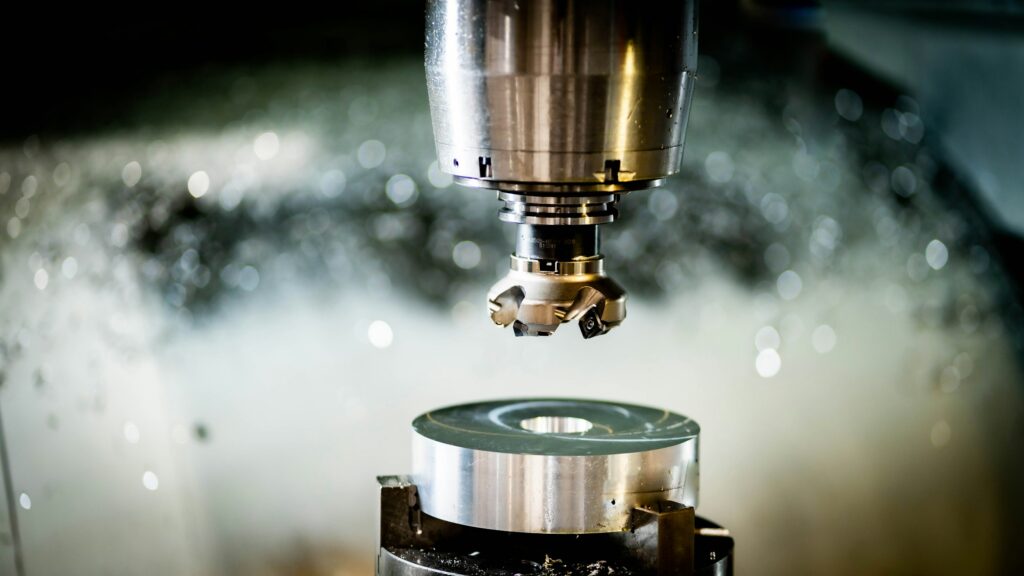
Aluminum is one of the easiest metals to machine. Titanium is one of the harder ones, for several reasons:
- Heat stays at the cutting edge. Titanium’s low thermal conductivity concentrates heat at the tool instead of carrying it away with the chip, which wears tools quickly.
- It’s springy. Thin walls deflect away from the tool, causing chatter.
- It reacts with tool materials and tends to build up on cutting edges.
The result is slower cutting. Carbide tools roughing Ti-6Al-4V typically run around 50 meters per minute, far below aluminum cutting speeds, and tool life can be measured in minutes if the process isn’t right. Raw titanium also costs much more per pound, and scrap from machining is expensive. Together, that often puts a titanium part at several times the cost of the same part in aluminum. Choosing a shop with titanium experience matters as much as the material choice.
Finishing
Aluminum is usually anodized for corrosion and wear resistance, or chem-filmed for conductivity and paint adhesion. Titanium is often left bare, passivated, or anodized for color coding on medical and aerospace parts. Our finishing team can help match the finish to the alloy.
How to decide
- Choose 6061 aluminum for general machined parts, housings, fixtures, and prototypes where cost and machinability lead.
- Choose 7075 aluminum when strength-to-weight matters and service temperatures are moderate. It’s a common aerospace structural alloy.
- Choose titanium when the part sees high temperatures, harsh corrosion, or the body, or when you need the last margin of strength in the smallest envelope.
How PE sources aluminum and titanium parts
PE’s CNC machining network machines aluminum daily and includes shops with proven titanium experience for aerospace, defense, and medical work. We match titanium jobs only to shops approved for that material, review drawings for features that drive titanium cost, and inspect every part in San Clemente before it ships.
Frequently asked questions
Yes. Ti-6Al-4V has roughly three times the tensile strength of 6061-T6 aluminum. On strength-to-weight, it’s well ahead of 6061 but only slightly ahead of 7075-T6.
No. Titanium is about 60% denser than aluminum. It’s lighter than steel and can make lighter parts than aluminum only when its higher strength allows thinner sections.
Titanium conducts heat poorly, so heat builds up at the cutting edge and wears tools quickly. It’s also springy and reactive with tool materials, which forces slower cutting speeds.
Send us the drawings.
A real person will contact you within 24 hours.