Laser cutting is the first step for most sheet metal parts, and the flat pattern you send decides how fast and cheaply it gets cut. A fiber laser can cut almost any profile, which makes it easy to design features that cut poorly, distort, or need cleanup afterward. A few design rules keep laser-cut parts accurate and inexpensive, whether they ship flat or move on to forming and welding.
How laser cutting of metal sheets works
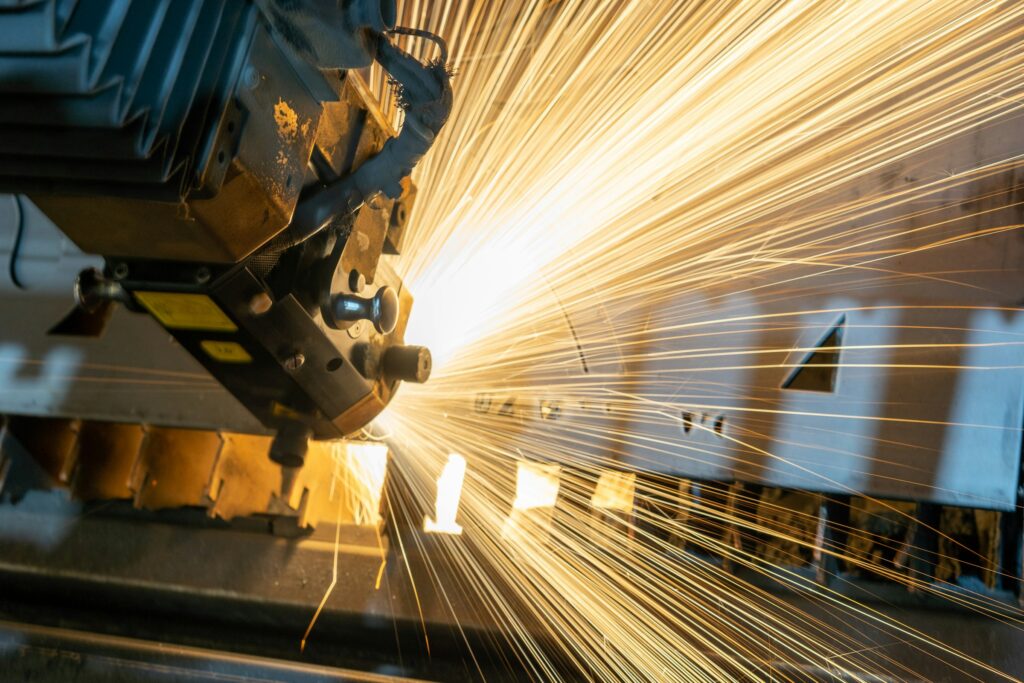
A focused laser beam melts the metal along the cut path while an assist gas blows the molten material out of the cut. Most modern shops run fiber lasers, which cut steel, stainless, aluminum, brass, and copper. The width of material removed is called the kerf. Shop software offsets the cutting path by half the kerf automatically, so you should draw parts at their nominal size.
The assist gas affects the edge. Oxygen speeds up cutting on mild steel but leaves a thin oxide layer on the edge that may need removal before welding or powder coating. Nitrogen produces a clean, oxide-free edge on stainless and aluminum at a slower speed and higher gas cost.
What thickness can a laser cut?
Capability depends on laser power and material. As a rough reference, a 6 kW fiber laser can cut mild steel up to about 22 to 30 mm and stainless or aluminum up to about 12 to 20 mm. Those are maximums. Speed drops and edge quality falls near the limit, so production work typically runs well below them. Very thick plate is often better suited to plasma or waterjet.
Tolerances to expect
On thin sheet, laser-cut features typically hold about ±0.005″ (±0.1 mm). Tolerances widen as thickness increases, and the heat-affected zone along the edge grows too. If a slot or tab needs to fit a mating part tightly, design it to the tolerance band rather than to nominal, and say on the drawing which side of the tolerance the fit needs.
Seven design tips for laser-cut parts
1. Make holes at least as large as the material thickness
Holes smaller than the sheet thickness are hard to cut cleanly and may come out tapered or with dross. A hole diameter of at least one times the material thickness is a safe rule. If you need a smaller hole in thick plate, plan to drill or ream it afterward.
2. Keep features away from the edges
Holes and slots too close to the edge of the part can distort or burn through. Keep them at least one times the material thickness from an edge, and 1.5 times is safer.
3. Leave enough material between features
Thin webs between holes or slots overheat and warp. Leave at least 1.5 times the material thickness between adjacent cut features.
4. Add radii to inside corners
The laser can cut a sharp inside corner, but corners concentrate stress and can crack once the part is formed or loaded. An inside radius about equal to the material thickness strengthens the part at no added cost.
5. Design for the next step
If the part will be bent, hole and slot placement has to account for forming. Holes closer than about 2.5 times the thickness plus the bend radius to a bend line tend to stretch. Add bend relief where a bend ends at an edge. Our sheet metal design guide covers forming rules in detail.
6. Plan for small parts and nesting
Parts are nested together on a full sheet to reduce scrap. Very small parts, under about 2″ in any direction on thin stock, often need micro-tabs to stay in the sheet during cutting, and those tabs leave small marks to break off and dress. If a cosmetic edge can’t show a tab mark, note it on the drawing.
7. Engrave or etch instead of cutting text
Cut-through lettering creates tiny islands that fall out. If you need part numbers or logos, call for laser etching or marking, or use a stencil font with bridges.
Material notes
- Mild steel cuts quickly with oxygen assist. Plan for edge cleanup if the part will be painted or welded.
- Stainless steel is typically cut with nitrogen for a clean, weld-ready edge.
- Aluminum reflects and conducts heat, so it cuts slower than steel at the same thickness and can leave more dross on the bottom edge.
- Copper and brass are highly reflective. Fiber lasers handle them, but thickness limits are lower.
What to send for an accurate quote
- A 3D model and a flat pattern (DXF or STEP), drawn at nominal size
- Material type, alloy, temper, and thickness
- Quantity and any cosmetic edge requirements
- Downstream steps: forming, hardware, welding, and finishing
How PE sources laser-cut parts
PE’s sheet metal fabrication network runs fiber laser cutting along with forming, welding, hardware, and finishing, so flat parts and finished assemblies come from one order. We review flat patterns before quoting and flag features that will cut poorly or distort in forming. We support advanced energy and industrial programs, and every part is inspected in San Clemente before it ships.
Frequently asked questions
A safe rule is a hole diameter at least equal to the material thickness. Smaller holes are possible in thin sheet but can come out tapered or rough in thicker material.
On thin sheet, laser cutting typically holds about ±0.005″ (±0.1 mm). Accuracy decreases as material thickness increases.
Oxygen cuts mild steel faster but leaves an oxide layer on the edge. Nitrogen gives a clean edge on stainless and aluminum and is preferred when parts will be welded or coated without edge prep.
Send us the drawings.
A real person will contact you within 24 hours.