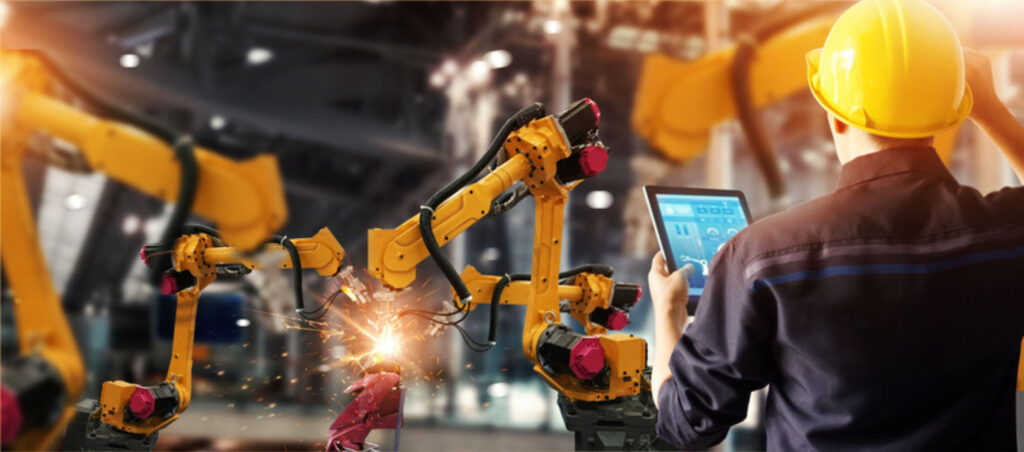
North American robot orders were up almost 25% year over year in Q3 2026, according to the Association for Advancing Automation (A3): 10,989 units, nearly $723.5 million worth, with semiconductor and electronics orders up 97.6% and automotive components up 90.4%. Automation isn’t a someday story anymore. It’s happening right now, across nearly every sector we build for.
But here’s what the quarterly stat roundups don’t mention: every one of those robots needs something built around it. Brackets. Housings. End-effectors. Mounting plates. Cable carriers. Vision-system brackets. Custom fixtures that hold the part while the robot does its job. None of that comes off a shelf, and almost none of it gets made the same way the robot itself does.
The Part Nobody Budgets For
When an engineering team specs out an automation cell, the robot gets the line item, the lead time estimate, and the project plan. The supporting hardware, the stuff that actually integrates the robot into a real production line, gets handled almost as an afterthought, right up until it isn’t.
Then it turns out the end-of-arm tooling plate needs a flatness tolerance tighter than anyone budgeted for. The mounting bracket has to be machined from a material the catalog shop doesn’t stock, because it’s sitting six inches from a weld cell and needs to survive the heat. The vision-system bracket has to hold position within a few thousandths or the whole pick-and-place routine drifts. And all of it is needed on a timeline that doesn’t match a standard 12-week lead time, because the integrator is already on-site and the line can’t go live without it.
That’s not a corner case. That’s most automation integration work.
Why the Gap Is Getting Wider, Not Narrower
It would be one thing if this were just a demand problem, with more robots ordered, more supporting parts needed, and shops scaling up to match. But the capacity to do this kind of work is shrinking at the same time demand for it is climbing.
A 2026 Manufacturing Outlook from CADDi and the Society of Manufacturing Engineers, surveying more than 200 U.S. manufacturing professionals, found that 79% of leaders cite the shortage of skilled workers as the single biggest barrier to growth, ahead of rising costs (61%) and tariffs (47%). Ninety percent said it hits manufacturing departments hardest, ahead of operations (48%) and design and engineering (40%). That’s the exact skill set this kind of work depends on: someone who can read a tolerance stack-up, understand why a fixture needs to be held a certain way, and catch a problem before it becomes a scrapped part.
Put those two trends next to each other (robot orders climbing nearly 25% a year, and the workforce that builds the parts around them shrinking) and the bottleneck isn’t hard to predict. It’s already here for a lot of engineering teams; it’s just not the line item anyone budgeted for.
Why “Quick Quote” Shops Pass
Mass-market CNC portals are built for a specific kind of job: simple geometry, decent volume, standard materials, fast turnaround on parts that don’t need much engineering judgment. That’s a fine model for that kind of part.
Low-volume, high-complexity, first-article-heavy work is a different animal. It takes a real conversation about tolerance stack-up, material behavior, and what happens if the fixture is off by two thousandths. A shop optimized for volume either quotes that job slowly, declines it outright, or prices it like they don’t really want it. Engineers who’ve been burned by that know the feeling: the part that should’ve taken two weeks took six, because nobody on the other end actually understood what they were building. Or worse, it came back out of tolerance and the automation cell sat idle while a new one got machined.
What Actually Solves It: Custom CNC Machining for Tight-Tolerance Parts
This is the work we built Precision Expedited around: not the easy parts, the ones everyone else turns away. Complex geometry, tight tolerances, odd materials, tiny volumes, and a deadline that matters.
The difference isn’t really the machines. It’s the process around them. Every quote starts with an actual design-for-manufacturability review, not just a price, because catching a tolerance that doesn’t need to be that tight, or a material call that doesn’t need to be that exotic, is often the difference between a two-week part and a six-week one. And it’s who’s on the other end of the phone: a single point of contact who understands the full picture (material, tolerance, finish, deadline) instead of a part getting routed through a ticket queue and re-explained to someone new every time.
We apply the same quality discipline to the bracket that holds your robot’s end-effector that we’d apply to an aerospace part, because increasingly that bracket needs the same traceability anyway: inspection records, material certs, a documented process that holds up if someone asks questions about it six months later.
What to Ask Before You Commit to a Supplier
If you’re sourcing the parts around an automation build right now, a few questions tend to separate a real manufacturing partner from a shop that’s just going to quote you a number. Ask whether they’ll flag a tolerance or material call that doesn’t need to be as tight or exotic as specified, before they quote it, not after. Ask who you’ll actually talk to if something changes mid-build: a name, not a ticket number. Ask what happens if the first article doesn’t pass inspection: do they eat the redo, or does that become your problem on your timeline. And ask how they’d handle a part that needs to be requalified because a material substitution shows up mid-order, because with the supply chain pressure on raw materials right now, that’s not a hypothetical.
The Takeaway
Automation spending isn’t slowing down. The semiconductor, automotive, and life sciences numbers from this last quarter make that clear, and the labor data suggests the shops that can actually do this work aren’t multiplying nearly as fast as the demand for it. The real question for anyone running one of these projects isn’t whether you’ll eventually need a complex, tight-tolerance part that doesn’t fit a catalog order. It’s whether you’ve already got someone who picks up the phone when you do.
If you’ve got a part like that sitting in a drawer because nobody wanted to quote it, that’s exactly the kind of call we like getting.