A quote for custom CNC machining is only as good as the information behind it. When a package is missing a material temper, a finish spec, or a certification requirement, the shop has two choices: stop and ask, which costs days, or assume, which costs money later. Most quotes that come back wrong, or change after the PO, trace back to something that wasn’t in the original request.
Here’s what to send so your quote reflects the part you actually need.
1. A 3D model in a neutral format
Send a STEP file (.stp or .step). It opens in nearly every CAM system without translation errors, and the shop uses it to program toolpaths and estimate machining time. Native files from your CAD system are useful as a backup but not every shop can open them.
Don’t model threads in 3D. Model the tap drill or major diameter and call out the thread on the drawing. Modeled threads slow down programming and can confuse automated quoting tools.
2. A 2D drawing with tolerances
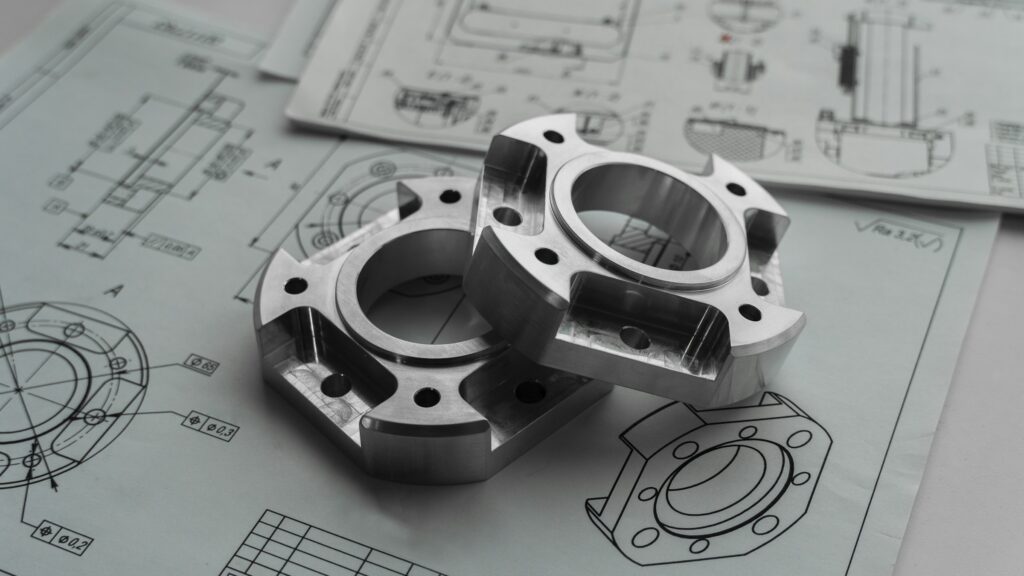
The model shows geometry. The drawing shows requirements. A complete drawing includes:
- Revision letter, matching the model
- General tolerances in the title block, plus specific tolerances on critical features
- GD&T with a datum scheme that reflects how the part mounts
- Thread callouts with size, pitch, class, and depth
- Surface finish requirements, called out only where they matter
- Edge break and deburr requirements
- Any notes on cosmetic surfaces, part marking, or inspection
If the drawing and model disagree, the shop has to ask which one governs. Most drawings state that the drawing takes precedence. Make sure both match before you send them. Our post on why quotes come back wrong shows what happens when they don’t.
3. Material, including alloy, temper, and spec
“Aluminum” isn’t enough. Specify the alloy and temper, such as 6061-T6 or 7075-T651, and the material specification if your program requires one. Stainless grades, titanium grades, and plastics vary just as much. Say whether certified material with mill certs is required, and whether domestic material or DFARS-compliant specialty metals are required for defense work.
4. Finish and post-processing
Name the finish and the spec: for example, anodize per MIL-A-8625 Type II, Class 2, black, or Type III hard coat with a thickness callout. Include heat treat, passivation, plating, or paint requirements, and any masking. Finishing often runs at an outside vendor, so it affects both price and lead time. Our finishing and post-processing page lists common options.
5. Quantities, including future volume
Ask for price breaks at the quantities you’re likely to order: prototype, pilot, and production. Unit cost drops sharply as setup and programming are spread across more parts. Sharing expected annual volume also lets the shop suggest a better process or fixture strategy for the long run.
6. Documentation and inspection requirements
State what needs to ship with the parts:
- Certificate of conformance
- Material certs and finish certs
- First article inspection report, including AS9102 format for aerospace programs
- Dimensional reports on critical features, or full CMM reports
- Any customer quality clauses that must be flowed down
Inspection requirements can add real time to a job. They should be priced in from the start, not added after the parts are made.
7. Export control and data markings
If your drawing contains ITAR-controlled technical data or Controlled Unclassified Information, mark it clearly and tell the supplier before you send it. Ask how they’ll handle it. That determines which shops can quote the job at all.
8. Required delivery date
Give the date you actually need parts, not an artificially early one. If the date is fixed, say so. A supplier can often hit a hard date by sequencing finishing or splitting a shipment, but only if they know it’s hard.
A quick RFQ checklist
- STEP model, current revision
- PDF drawing, same revision
- Material alloy, temper, and spec; certs required?
- Finish and post-processing specs
- Quantities and expected annual volume
- Documentation and inspection requirements
- ITAR or CUI status
- Required delivery date
How PE quotes custom CNC machining
Every RFQ PE receives goes through engineering review before it’s quoted. If something’s missing or a callout is driving cost without a clear reason, we ask before quoting rather than assume. That’s the difference between an automated price and an engineered quote, which we covered in Instant Quotes vs. Engineered Quotes. Our CNC machining network handles everything from prototypes to production, and every part is inspected in San Clemente before it ships.
Frequently asked questions
A STEP file for the 3D model plus a PDF drawing with tolerances, threads, finishes, and notes. STEP opens reliably in almost every CAM system.
No. Model the hole at the tap drill or major diameter and call out the thread on the drawing. Modeled threads slow programming and can cause quoting errors.
Usually because something wasn’t in the original package, such as a material spec, finish, certification, or inspection requirement. Sending a complete package up front prevents most changes.
Send us the drawings.
A real person will contact you within 24 hours.