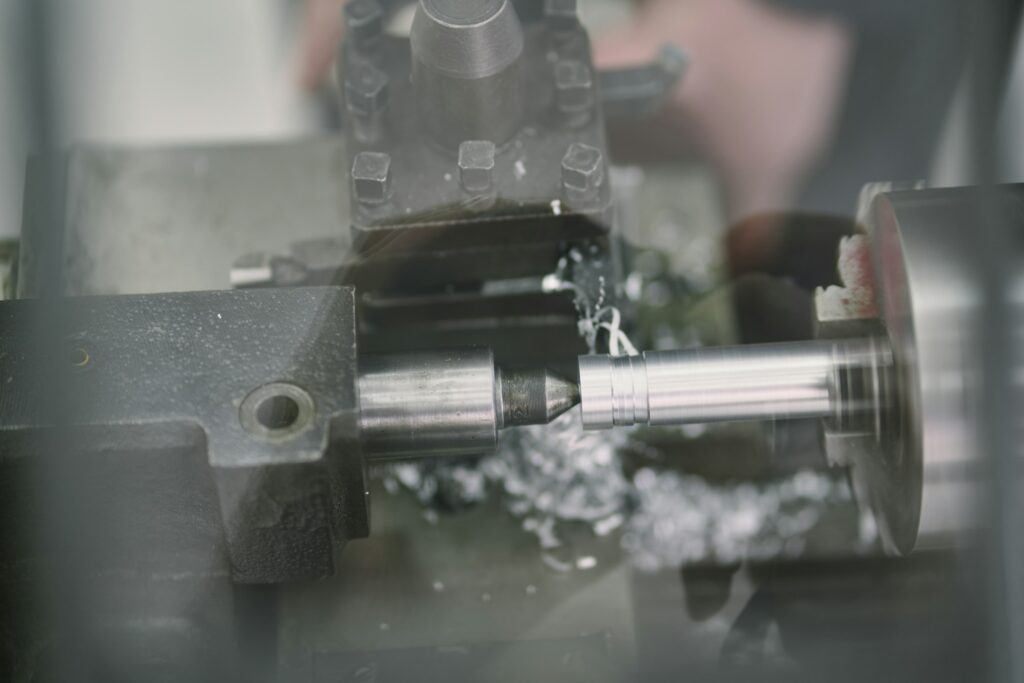
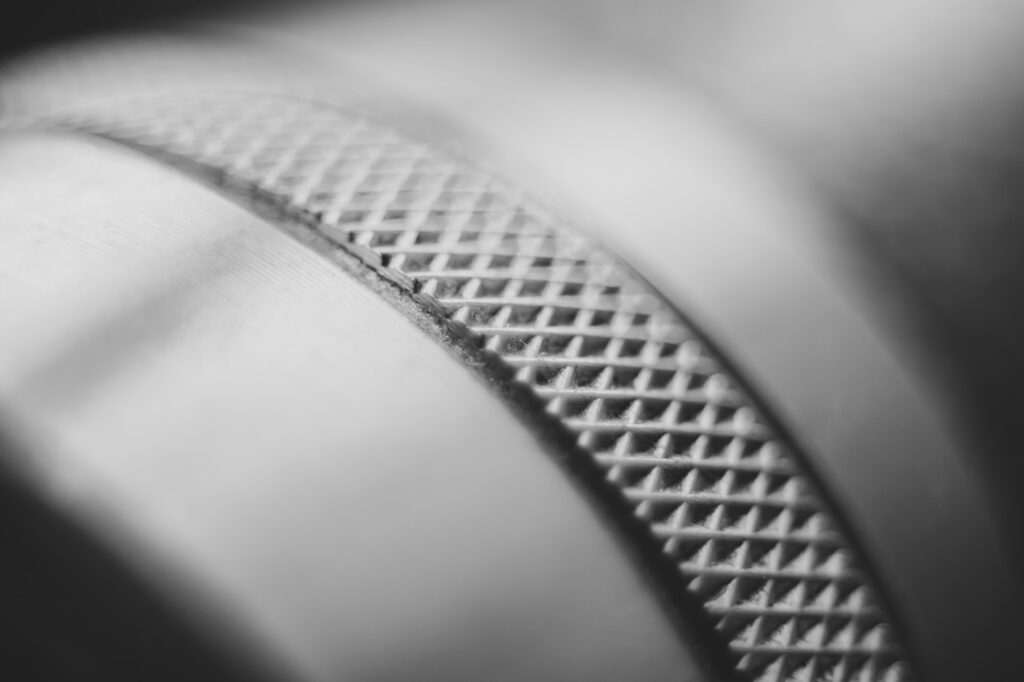
Knurling looks like a cosmetic detail, and on a lot of drawings it gets treated like one: a note that says “knurl” with an arrow to the diameter. That note leaves the pattern, the pitch, the process, and the finished diameter up to whoever runs the lathe. On a grip knob that might be fine. On a press-fit insert or a part that has to look the same across production lots, it isn’t.
This guide covers the knurl patterns, the difference between form and cut knurling, how pitch and blank diameter work, and how to call out knurling so every shop in your supply chain makes the same part. It applies to knurled features on CNC machined parts, most often on a lathe.
What knurling does
Knurling puts a regular pattern of ridges on a cylindrical surface. It’s used for three main jobs:
- Grip. Thumbscrews, knobs, handles, and adjustment rings on surgical instruments and handheld devices.
- Press fits. A straight knurl on a shaft or insert bites into a softer mating part, such as a plastic housing or a hub, to stop it from rotating.
- Appearance. A clean, consistent knurl signals quality on consumer and industrial products.
The job decides how much the details matter. A grip knurl is forgiving. A press-fit knurl has a functional diameter that controls the fit, and it needs a real tolerance.
Knurl patterns
| Pattern | What it looks like | Common uses |
|---|---|---|
| Straight | Ridges parallel to the part axis | Press fits into plastic or soft metal, inserts, torque transfer |
| Diagonal (helical) | Ridges at an angle, usually 30° to the axis | Grip, decorative surfaces |
| Diamond (male) | Two crossed diagonals with raised, pointed diamonds | Most hand grips: knobs, handles, thumbscrews |
| Diamond (female) | Crossed pattern with recessed diamonds | Softer-feeling grips |
In the US, knurling tools and patterns are standardized under ASME B94.6. Germany’s DIN 82 (ISO 13444 internationally) covers the same family of patterns with its own letter codes, such as RAA for straight and RGE for a raised diamond. If your drawing will go to suppliers in more than one country, naming the standard avoids confusion.
Form knurling vs. cut knurling
This is the decision that drives quality, cost, and diameter control. Both make the same visual pattern in different ways.
Form knurling
Hardened wheels press into the rotating part and push material up into ridges. Nothing is removed. Because material is displaced, the finished outside diameter grows larger than the starting blank. Form knurling is fast and common, but it puts a lot of force into the part, which can bend slender shafts or crush thin-walled tubes. It also works poorly on hard or brittle materials.
Cut knurling
Cutting wheels or tools remove material to create the pattern, much like cutting a thread. Cut knurling takes more cycle time, but it uses far less force, holds the outside diameter more predictably, and handles harder materials and thin walls better. Many CNC lathes and Swiss machines can cut knurls in the same setup as the rest of the part.
Rule of thumb: form knurling for simple grip features on robust parts in soft materials. Cut knurling for precision diameters, thin walls, slender parts, hard materials, or press fits with a tight fit tolerance.
Pitch: how coarse or fine
Pitch sets the size of the teeth. ASME B94.6 defines knurls by diametral pitch, with standard values of 64, 96, 128, and 160. Higher numbers are finer. The standard gives 96 preference to keep tooling simple. Many shops and catalogs still talk in teeth per inch (TPI), such as 21, 25, 30, or 35 TPI, so it’s worth knowing that the two systems are different.
- Coarse knurls give a strong grip on larger diameters and work better in soft materials.
- Fine knurls suit small diameters, harder materials, and cosmetic surfaces.
Blank diameter: why “tracking” matters
For a form knurl to come out clean, the wheel teeth have to land in the same grooves on every revolution. If the circumference of the blank isn’t close to a whole number of teeth, the teeth “double track” and leave a messy, shallow pattern. ASME B94.6 solves this with diametral pitch: blanks that are multiples of 1/64 inch (for 64 and 128 pitch) or 1/32 inch (for 96 and 160 pitch) track cleanly.
What this means for your drawing: if the knurl diameter isn’t critical, let the shop choose a blank that tracks well. If it is critical, specify the finished diameter after knurling and let the shop work backward to the blank, or specify cut knurling, which avoids most tracking problems.
How to call out knurling on a drawing
A complete callout answers five questions:
- Pattern: straight, diagonal, or diamond (male or female).
- Pitch: diametral pitch (for example, 96 DP) or TPI, and which standard.
- Process: form or cut, if it matters for your part.
- Diameter: the finished diameter after knurling, with a tolerance if the knurl is functional.
- Length and location: where the knurl starts and stops, plus any chamfer at the ends.
Example: “MEDIUM DIAMOND KNURL, 96 DP, PER ASME B94.6. CUT. Ø.500 +.002/-.004 AFTER KNURL. .75 LONG.” That tells any qualified shop exactly what to make.
Design tips that keep knurls clean and affordable
- Chamfer the ends. A small chamfer at each end of the knurl gives the tool a clean entry and removes sharp edges.
- Leave room for the tool. Knurls next to a shoulder are harder to make. Give the tool some clearance, or accept a short partial pattern at the shoulder.
- Watch slender parts. Form knurling force can bend long, thin shafts. Support the part, shorten the knurl, or specify cut knurling. Our CNC turned parts design rules cover length-to-diameter limits.
- Plan the finish. Plating and anodizing build up on knurl peaks and can fill fine knurls. Tell your finishing team about knurled areas so they can mask or adjust.
- Don’t over-tolerance grip knurls. If the knurl is only for grip, a loose diameter tolerance saves time and inspection cost. Our post on drawing callouts that raise your quote covers more ways tight callouts add cost.
How PE sources knurled parts
Knurled features show up on turned parts across our industrial and medical programs, from thumbscrews to press-fit inserts. We review the callout before quoting, flag missing pattern, pitch, or diameter details, and match the job to a lathe or Swiss shop in our network that’s set up for the process your part needs. If you’re not sure which process fits, see our guide to CNC machining processes.
Frequently asked questions
Form knurling increases the outside diameter because it pushes material up into ridges. Cut knurling removes material and holds the diameter more predictably. Always specify the diameter after knurling if it matters.
The medium male diamond knurl is the most common pattern for hand grips. Straight knurls are most common for press fits.
Diametral pitch, used by ASME B94.6, is the number of teeth per inch of knurl tool diameter. TPI counts teeth per inch along the work surface. They’re different systems, so name the one you’re using.
Yes, but hard and work-hardening materials are better suited to cut knurling, which uses less force and gives a cleaner result.
Send us the drawings.
A real person will contact you within 24 hours.