CNC machining covers several different processes that share one idea: a computer-controlled machine removes material from solid stock to make a part. Which process a shop uses depends on the part’s shape, size, material, tolerances, and quantity. Knowing the differences helps you design parts that machine efficiently and read quotes with a better sense of where the cost comes from.
This guide walks through the main CNC machining processes buyers and engineers run into, what each is good at, and the tolerances you can typically expect.
CNC milling
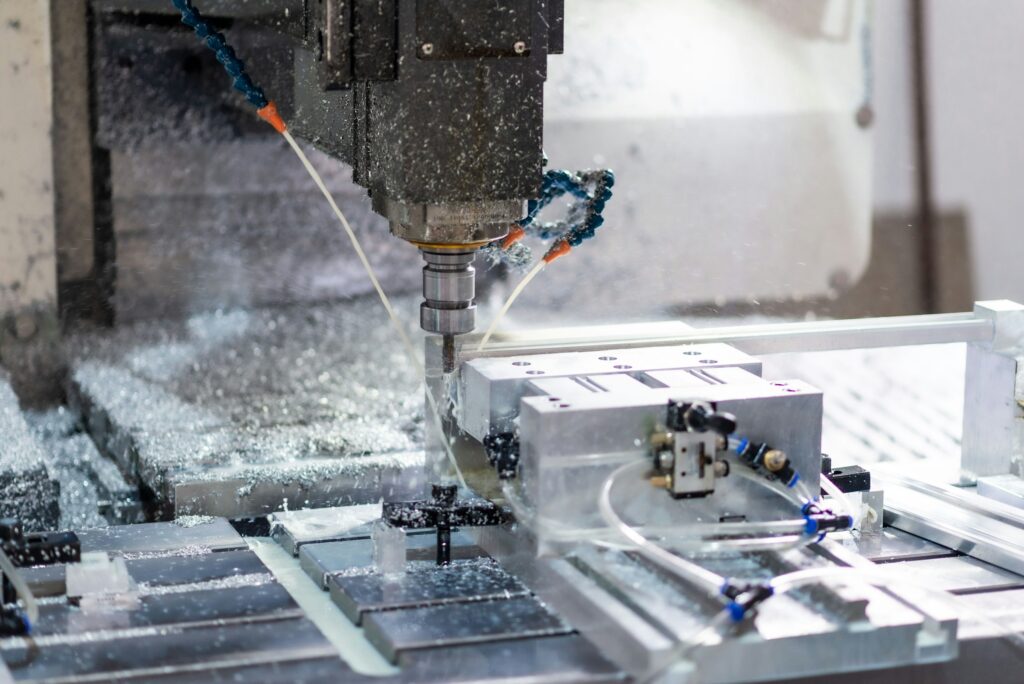
In milling, the workpiece is clamped in place and a rotating cutter moves across it. Milling handles flat faces, pockets, slots, holes, and contoured surfaces, which makes it the most common process for prismatic parts like housings, brackets, plates, and manifolds.
3-axis milling moves the cutter in X, Y, and Z. It’s fast and economical for parts where features are reached from one direction at a time, with the part flipped for additional setups.
5-axis milling adds two rotational axes, so the cutter can reach the part from almost any angle in one setup. That cuts setup time and stack-up error on complex parts like impellers, aerospace brackets, and parts with compound angles. It costs more per hour, so it pays off when it removes setups or makes a geometry possible. We covered the decision in 5-Axis vs. 3-Axis CNC Machining.
Typical tolerance: standard milling holds about ±0.005″ (±0.125 mm) without special effort, and ±0.002″ or tighter on controlled features with added cost.
CNC turning
In turning, the workpiece spins and a stationary cutting tool shapes it. Turning makes round parts: shafts, pins, bushings, spacers, fittings, and threaded components. Modern turning centers with live tooling can also drill cross holes and mill flats without moving the part to a mill.
Typical tolerance: turning often holds diameters tighter than milling holds comparable features, commonly ±0.001″ (±0.025 mm) on controlled diameters.
Swiss machining
Swiss-type lathes feed bar stock through a guide bushing that supports the material right next to the cutting tool. That support lets them make long, slender parts that would bend on a conventional lathe, which starts to deflect at around 3:1 length to diameter. Swiss machines routinely make parts at 10:1 and beyond.
Swiss machining suits small-diameter parts, typically under about 1.25″ (32 mm), made in high volumes: medical screws and pins, connector contacts, and precision shafts. Multiple tools cut at once, so cycle times are short once the job is set up.
Wire EDM
Wire electrical discharge machining cuts with a thin, electrically charged wire, typically 0.004″ to 0.012″ in diameter, that erodes material with controlled sparks. The wire never touches the part, so there’s no cutting force. That lets wire EDM cut hardened tool steel, carbide, titanium, and nickel alloys as easily as softer metals, and produce sharp inside corners limited only by the wire radius.
Wire EDM holds tight tolerances, commonly ±0.0005″ and as tight as ±0.0001″ on precision setups, with fine surface finishes. The trade-offs are speed and material: it’s slower than milling, and it only cuts electrically conductive materials. It’s the right call for punch and die components, keyways, gear profiles, thin slots, and parts already heat treated.
Grinding and other finishing processes
When a feature needs to be tighter or smoother than milling or turning can hold economically, shops grind it. Precision grinding holds tolerances near ±0.0001″ (±0.0025 mm) on bearing journals, gauge surfaces, and sealing faces. Grinding adds a setup and cost, so it should be called out only on features that need it.
How the processes compare
| Process | Best for | Typical tolerance | Watch for |
|---|---|---|---|
| 3-axis milling | Prismatic parts, plates, housings | ±0.005″ standard | Extra setups on multi-sided parts |
| 5-axis milling | Complex geometry, compound angles | ±0.005″ standard, tighter on controlled features | Higher hourly rate |
| Turning | Round parts, shafts, threads | ±0.001″ on controlled diameters | Long, slender parts deflect |
| Swiss machining | Small, slender parts at volume | Tight, repeatable at volume | Setup cost on low quantities |
| Wire EDM | Hardened material, sharp inside corners, thin slots | ±0.0005″ common | Slower; conductive materials only |
| Grinding | Very tight or smooth features | Near ±0.0001″ | Added operation and cost |
Choosing the right process for your part
Most real parts use more than one process. A turned shaft may get milled flats and a ground bearing journal. A milled aerospace bracket may get a wire EDM slot after heat treat. Four questions usually decide the routing:
- Is the part mostly round or mostly prismatic? Round parts start on a lathe. Prismatic parts start on a mill.
- Is the material hardened or hard to cut? Wire EDM and grinding handle hardened material that would wear out cutting tools.
- How many sides need features? More sides favor 5-axis or mill-turn equipment to avoid repeated setups.
- What quantity? High volumes of small round parts favor Swiss machines. Low volumes favor whatever needs the least setup.
Tolerance and finish callouts drive the choice too. For more on what tight tolerances cost, see CNC Machining Tolerances: What ±0.001″ Actually Means.
How PE sources CNC machined parts
PE’s CNC machining network covers 3-axis and 5-axis milling, turning, Swiss machining, wire EDM, and grinding. Our engineering team reviews each drawing, decides the routing, and places the job with a shop whose equipment fits the part, including multi-process parts that move between shops. Every part comes back to San Clemente for inspection before it ships, for programs from industrial automation to aerospace and defense.
Frequently asked questions
In milling, the part stays still and a rotating cutter moves across it, which suits flat and prismatic parts. In turning, the part spins against a stationary tool, which suits round parts like shafts and pins.
Use wire EDM for hardened materials, sharp inside corners, very thin slots, or features with tolerances tighter than milling holds economically. Wire EDM only cuts electrically conductive materials.
Standard CNC machining holds about ±0.005″. Turning commonly holds ±0.001″ on controlled diameters, wire EDM ±0.0005″ or tighter, and grinding near ±0.0001″.
Send us the drawings.
A real person will contact you within 24 hours.